|
|||||||||||||||
|
Startlingly
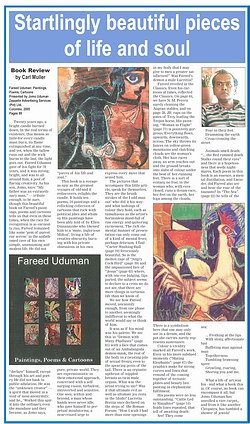
beautiful pieces of life and soul Twenty years ago, a bright candle burned down. In the real terms of existence, this means so little for every candle must burn, its flame extinguished at any time, and yet, when the tallow runs out and the wick burns to the last, the light goes out. Fareed Uduman gave of his light for 78 years, and it was strong, bright, and was to all around him, a pool of flaring creativity. As his son, Jomo, says: “My father was an extraordinary man,” -tribute enough, to be sure, though this beautiful book on Fareed’s paintings, poems and cartoons tells us that even in these times, when the race for recognition is so earnestly run, Fareed remained like some ‘gem of purest ray serene’ in the unfathomed cave of his own simple, unassuming and modest life. He did not “declare” himself, except through his art and poetry. He did not bask in public adulation. He was the “unknown creator” -a spirit that moved in a void of nearanonymity; and he worked this spirit into the ordinary, even the mundane and they became, as Jomo says, “pieces of his life and soul.” This book is a voyage- as epic as the greatest voyages of oldand it rediscover, relights the candle. It holds ten poems, 34 paintings and a rollicking collection of cartoons that rock with political jibes and whimsy. His paintings have been ably told of by Ellen Dissanayake who likened him to a ‘mute, inglorious Milton’, living a life of creative obscurity, burning with his private obsessions in his own pure, private world. They are expressionistic in their emotional approach, concerned with a self surging vision, turbulent, introverted and sensitive. One sees, within and beyond, a man whose hands were never idle, who gave himself to perpetual mindstorms, a near-crazed urge to express every move that seized him. The pictures that accompany this little article, speak for themselves. They are the brush strokes of the ‘odd man out who did it his way- and what lashings of colour they hold, each as tumultuous as the artis’s horizonless mind-full of raw energy and quivering excitement. The rich elemental manner of presentation can only come out of a kind of mental fever, perhaps delirium. I find “Carter Washing Bull (page 19) ferociously beautiful. So is the molten rage of “Angry Cock Bird” (page 39) and the impassioned face of “Jesus” (page 63) where, with one eye bulging, lips parted, the subject seems to declare to a cross we do not see, that there are more things in tortuous life than we know of. Sexual frenzy... We see how Fareed, moved, uncannily enough, from one phase to another, seemingly indifferent to what the world would say or think of him. It was as if his mind was his palette. We see this in “Demon with Many Phalluses” (page 65) with a face that comes out of an Ambalangoda demon-mask, the rest of the body in a twisting pile of sexual frenzy. There is an orgiastic upthrust of nippled breasts as twin male organs. What was the artist trying to say? Was it that ultimate evil as well as ultimate joy rests in the libido? Lucretia Borzia once declared on the steps of the Roman Forum: “How I wish I had more than nine openings in my body that I may give to men a greater satisfaction!” Was Fareed’s demon a male Lucretia? Fareed revelled in the Classics. Even his cartoons at times, reflected the Classics. On page 64, we have N.M. Perera surely cleaning the Augean stables, and on page 58, J.R. raps on the gates of Troy, leading the Trojan horse. His painting, “Woman in Flight” (page 71) is positively gorgeous. Everything flows, upwards, downwards, across. The sky throws its lances on yellow- green mountains and clutching clouds are the woman’s cloth. Her hair races away, an arm reaches out and the ground breaks into slabs of colour under the beat of her running feet. There is a sort of ecstasy, no fear, in the woman who, with eyes closed, runs a dream-race, her feet on the earth, her hips among the clouds. There is a symbolism here that one may only see in a dream, and the pot she carries surely represents sustenance. Colour vividly marks all Fareed’s work. Even in his more subdued moments (“Mating Elephants”-page 67) the graphics make for strong curves and lines that remind of the coming together of tectonic plates- and beauty lies panting in elephantine fulfilment. Awaiting death His poems were no less outstanding. “Cattle Led to Slaughter” (page 14) holds lines repeated, that tell of awaiting death: See! They come Fear in their feet Drumming the earth Cross-crossing the street Animals smell death: the”...Red rimmed death/ Stalks round their eyes” and there is a hopelessness that seeds nightmares. Each poem in this book is an essence, a mental distillation, and I wonder, did Fareed also seen and hear the roar of the tsunami? In “The Sea” (page 22) he tells of the sea. ...”Frothing at the lips With stony, affectionate lust Buffeting man against man Togetherness Tumbling brawning spree Growling, roaring, Shoring you and me. What a life of art was his-and what a book this is. Of course, no book encompass it all, but Jomo Uduman has unrolled a rare carpet, and from it like another Cleopatra, has tumbled a shower of jewels! - Carl Muller |
|||||||||||||||
|








 The Island - Friday 10th June 05.